Do frontier AI developers
act on third-party risk findings?
Analyzing publicly available evidence of company responses to evaluations
Government AI institutes and independent evaluators test advanced systems for dangerous capabilities, safeguard failures, and other risks. An evaluation can document a serious vulnerability but does not oblige a developer to respond. This study asks a narrow question: when a government or an independent evaluator publishes a risk-relevant finding about a named frontier system, does the public record document company action that addresses the identified risk?
Who was evaluated, and by whom
The developers, models, risk domains and evaluating institutions in the dataset. Hover a bar for its exact count.
Key findings
Results for the significant-risk trackable findings, unless a chart says otherwise. The shortfall combines findings with no located public company response and findings whose documented response fell below the required Action Level or lacked explicit attribution. Hover any bar or point for its exact count.
The difference was not statistically significant after accounting for clustering within reports. By reporting configuration, the shortfall ranged from 80.0% for standalone UK AISI evaluations (16 of 20) to 100% for standalone US CAISI evaluations (4 of 4).
One company response had a reported independent retest
Anthropic reported that US CAISI tested its rebuilt cyber classifier before redeployment. In one additional case, UK AISI explicitly stated that it could not verify OpenAI's final mitigation after identifying a GPT-5.5 jailbreak. For the remaining 70 findings, the public record contained the company's own description of its response but no independent confirmation that the documented action was implemented or effective.
Policy uptake is documented for one in five findings but is almost entirely non-binding
A response has explicit attribution when the company names the finding, report, result, or evaluator, or states that this evidence informed its response. Outcomes shown as Proportionate require explicit attribution.
Share of significant-risk findings without a proportionate response, by publication year
The solid line is the share of each year's significant-risk findings without a proportionate response; the dashed line is the share with no located response. Findings published more recently have had less time to draw a response, so the years are not directly comparable. This is a descriptive view of the dataset.
What happens to a published finding
The path from the 1,120 findings to the 179 significant-risk findings whose company responses we coded.
Table view
How each finding was classified
Four coding steps sit between a published finding and its verdict. Each chart shows one step and what it produced.
A finding is trackable when it reports a specific adverse or safety-relevant result, names the model, system, or developer involved, and a concrete company response to the reported result can reasonably be assessed.
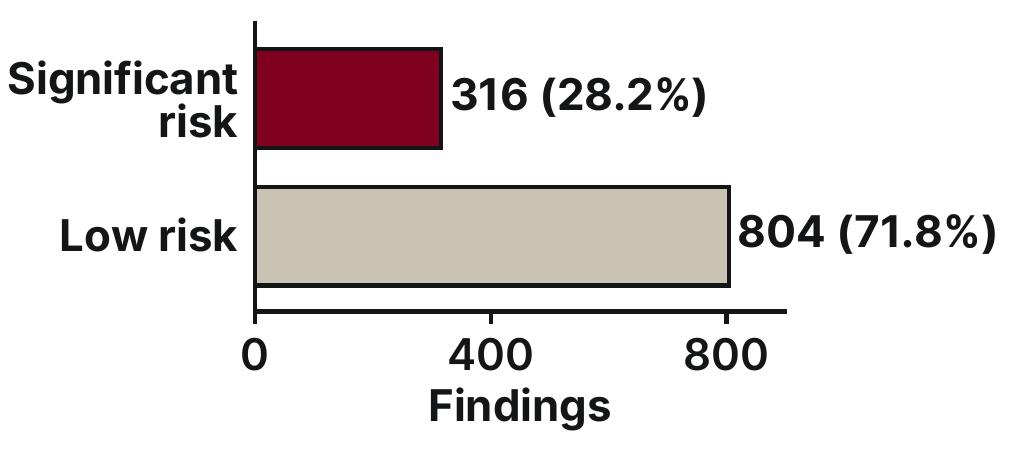
A finding is significant-risk when its reported evidence met at least one significant-risk threshold across eight domains. Three frontier models classified every finding, and two authors reviewed every finding against its source.
For each trackable evaluation finding, we ran three separate searches: company response, policy uptake, and public coverage. Only the company's own documents count as a company response.
Action Level records the strength of the publicly documented company response: a specific mitigation that directly addressed the problem (Substantive), an incomplete, interim or unverified action (Partial), an acknowledgment with no action specified (Acknowledged), or no public response identified (None).
Was the company response proportionate to the risk identified?
We operationalized the proportionality of a response using finding severity and Action Level.
Proportionate
A substantive response with explicit attribution for a significant-risk finding; a partial or substantive response with explicit attribution for a low-risk finding.
Under-response
A public response was documented, but it fell below the required Action Level or lacked explicit attribution.
No response
No publicly documented company response was located.
Trackable evaluation findings by severity (rows) and Action Level (columns). Cell color shows the outcome most findings in the cell received.
Proportionality outcomes for significant-risk and low-risk trackable evaluation findings.
Our proportionality annotations did not guarantee that the response was implemented, that it worked, or that the risk was completely mitigated.
An example of each outcome
| Outcome | n (% of 179) | Illustrative example |
|---|---|---|
| No publicly documented company response located | The AgentHarm benchmark, built by UK AISI and Gray Swan AI, found that several models complied with malicious agentic requests at high rates. The worst case, Mistral Large 2, recorded an 82.2% harm score against a 1.1% refusal rate. | |
| Documented response that did not meet the proportionality standard | UK AISI developed a universal jailbreak against GPT-5.5 in six hours of expert red-teaming. OpenAI reported nonspecific changes to its safeguard stack, but UK AISI could not verify that the final configuration was effective. | |
| Proportionate documented response | UK AISI and US CAISI found multiple universal jailbreaks bypassing the Constitutional Classifiers protecting Claude Opus 4 and 4.1. Anthropic responded by restructuring its safeguard architecture to address the underlying vulnerability class. |
What the dataset contains
The findings come from reports and are recorded under reporting-institution labels, including joint evaluator labels.
All findings by model access type.
All findings by the year the evaluation was published.
All findings by type of evaluator.
Go deeper
Methodology
Data collection and scope, trackable findings, risk severity classification, response evidence, proportionality and limitations.
Read the methodologyThe data
Search and filter every finding with its source, coded fields and reasoning, then download the full dataset as CSV.
Explore the dataMethodology
How the findings were collected, classified and traced to company, policy and public responses. This page follows Section 3 of the paper.
01Initial data collection and scope
Evaluator set and eligible reports
Our evaluator set comprises 46 organizations drawn from three sources: members of the International Network for Advanced AI Measurement, Evaluation and Science; members of the AI Evaluator Forum and other evaluators that publish frontier model findings; and evaluators named in frontier developers' reports. We collected 6,684 publication records from these organizations' websites, publication indexes, and research pages.
An evaluation report or paper was eligible if it named the evaluator and the tested system and described its methods and results in enough detail to support at least one evidence-backed finding. We screened most records by title and abstract, and read the full document only when those were not enough.
The unit of analysis is a finding
A finding is one discrete, evidence-backed claim that can be coded on its own. A report can contain several findings. Any model from a frontier developer was eligible, regardless of model size; the frontier-developer list comprises 14 developers.
- Findings about anonymized systems were included only when the report described those systems as frontier or an advanced system.
- We excluded evaluation reports in which a developer tested its own model, unless a named external evaluator took part in the system evaluation.
- We excluded models that an evaluator built or modified for its own study.
02Corpus composition and identifying trackable findings
Model access type
We classify a finding as pre-deployment when the evaluator tested the model before its public release, as post-deployment when the evaluator tested the released model, and as mixed when the evaluation used both. Post-deployment testing dominates the public record, producing 73% of all findings. For 99 findings, the access type of evaluation was not disclosed.
Type of evaluating institution
Nonprofit members of the AI Evaluator Forum produced 328 findings, government institutes 308, other nonprofits 245, and for-profit evaluators 239. Four organizations (UK AISI, Scale AI, METR, and Shanghai AI Laboratory) together produced 511 findings, or 45.6% of the corpus.
Three mutually exclusive tiers
Not every finding reasonably merits a company response. We therefore assigned each finding to one of three mutually exclusive tiers, based on whether it reports adverse findings, whether they are trackable, and whether they surface credible risks.
| Tier | Definition |
|---|---|
| Trackable evaluation findings 211 (18.8%) | A finding is trackable when it meets three conditions: it reports a specific adverse or safety-relevant result; it names the model, system, or developer involved; and a concrete company response to the reported result can reasonably be assessed. |
| Non-trackable evaluation findings 603 (53.8%) | Empirical findings that fail at least one of the three conditions. Examples include results about anonymized systems, null results, reassuring or inconclusive results, rankings with no concerning threshold, and industry-wide capability trends. |
| Non-empirical findings 306 (27.3%) | Findings that report no empirical model behavior or capability. They include contributions to methodology, frameworks, governance processes, and tooling. |
The three conditions for a trackable finding
It reports a specific adverse or safety-relevant result.
It names the model, system, or developer involved.
A concrete company response to the reported result can reasonably be assessed.
03Risk severity classification
Significant-risk and low-risk findings
Findings also differ in how adverse they are, and what counts as an adequate response depends on that.
- Significant-risk
- The finding's reported evidence met at least one significant-risk threshold across the eight domains below.
- Low-risk
- All remaining findings, which do not contain any significant-risk thresholds.
The eight domains
Severity was coded in two stages
First, we used three frontier models from different developers (Claude Sonnet 5, GPT-5.5, and Gemini 3.1 Pro) each to classify every finding independently using the same prompt, and their majority vote gave a provisional label. The three models agreed unanimously on 1,010 of the 1,120 findings (90.2%) and on 177 of the 211 trackable evaluation findings (83.9%).
Second, two authors independently reviewed every finding against its source, together with all three votes and rationales, and overrode the model majority where required. The final severity label agreed on by both authors differed from the model majority for 12 of 211 trackable findings.
04What responses and impacts did findings have?
Identifying a risk does not show whether any action was taken. We next traced the company, policy, and public responses that followed each of our 211 trackable evaluation findings.
Evidence channels: what actions followed a finding being reported?
For each trackable evaluation finding, we ran three separate agentic web searches, each prompted to find evidence of a different type of response with defined source evidence rules. All three searches covered public sources available by 29 August 2026.
- Company response
- The developer's newsroom, blog, and research index; later model and system cards; safety and deployment pages; and official statements. Only the company's own documents count.
- Policy uptake
- Official parliamentary, legislative, regulatory, and agency records. A record counts only if it refers to the finding.
- Public coverage
- Independent media, academic citations, and documented public discussion. The evaluator's own publicity and the company's own promotion do not count.
Attribution: did a company acknowledge the finding?
- Explicit attribution
- The company names the finding, report, result, or evaluator, or states that this evidence informed its response.
- No explicit attribution
- We located a qualifying response, but the company stated no link to the finding.
- No response located
- The search found no qualifying public response by the cutoff date.
Cases with no located response are recorded in this third category so that a completed negative search remains distinguishable from an uncoded one.
Action Level: was a finding acted on?
Action Level records the strength of the publicly documented company response. Only publicly available documents or statements published directly by the responding company were accepted as evidence.
- Substantive. The company documented a specific mitigation, model change, safeguard, access restriction, or deployment decision that directly addressed the identified problem.
- Partial. The company documented an action that addressed only part of the problem, described the action as interim, limited, or incomplete, or described changes without showing that the problem was addressed.
- Acknowledged. The company acknowledged the finding or underlying problem but specified no action.
- None. No public response could be identified through the search by the cutoff date.
| Action Level | Finding | Documented company response |
|---|---|---|
| Substantive | CAISI found two security vulnerabilities in ChatGPT Agent and combined them into a working exploit. | OpenAI fixed both vulnerabilities within one business day. |
| Partial | UK AISI found a universal jailbreak in GPT-5.5 within six hours. | OpenAI's system card reports several updates to its safeguards but states that UK AISI could not verify whether the final configuration was effective. |
| Acknowledged | UK AISI reported unsanctioned behavior by Claude Mythos 5 during a cyber evaluation. | Anthropic cited the incident in its 14 August risk report and reported an ongoing joint investigation. The report identified no specific mitigation for the finding by Anthropic. |
| None | Dreadnode found that GPT-5.4 recorded two benchmark passes involving cheating under the standard anti-cheating instruction and one under the strictest instruction. | No qualifying company document was located after the documented response search. |
Proportionality: was a company response proportionate to the risk identified?
We operationalized the proportionality of a response using finding severity and Action Level. For significant-risk findings, we required a substantive response with explicit attribution. For low-risk findings, we required a partial or substantive response with explicit attribution. An acknowledgment without action never meets the standard, and a finding with no located response is always coded as "no response".
* Outcomes shown as Proportionate require explicit attribution. Without explicit attribution, those responses are classified as Under-response.
Policy Level: did a finding have an impact on governance?
Policy Level measures the documented policy uptake for a finding. We did not count general policy activity concerning the same topic unless it referred to the finding.
- Binding policy action
- A government instrument imposed a mandatory requirement that is explicitly connected to the finding or to the same risk in the same model.
- Non-binding policy-related uptake
- The finding was cited or discussed but does not create any mandatory obligation, including through official statements, legislative records, consultations, recommendations, or guidance.
- No policy uptake identified
- No qualifying policy response was located for the finding.
05Limitations
The study is limited to evidence available in the public record through 29 August 2026. We assigned Action Level None when the search located no qualifying public company response by the cutoff. Private communication, preventive action, unattributed remediation, and unreported verification are therefore unobservable for this study.
Non-English reports were excluded from this study.
The data
Every row carries its source, its coded fields and the reasoning behind its tier.
| Date | Institution | Finding | Models | Severity | Response |
|---|